
Articles · Methods
A Prototype Is Cheaper Than an Apology
Every product team eventually ships the apology: the rollback, the mea culpa email, the 'we heard you' post. A working prototype, tested on real users, costs a fraction of any of them.
THE UX FRICTION REPORT
AI GENERATEDNEW ARTICLES BY EMAIL
Get notified when new articles are published.
That did not go through. Check the address and try again.
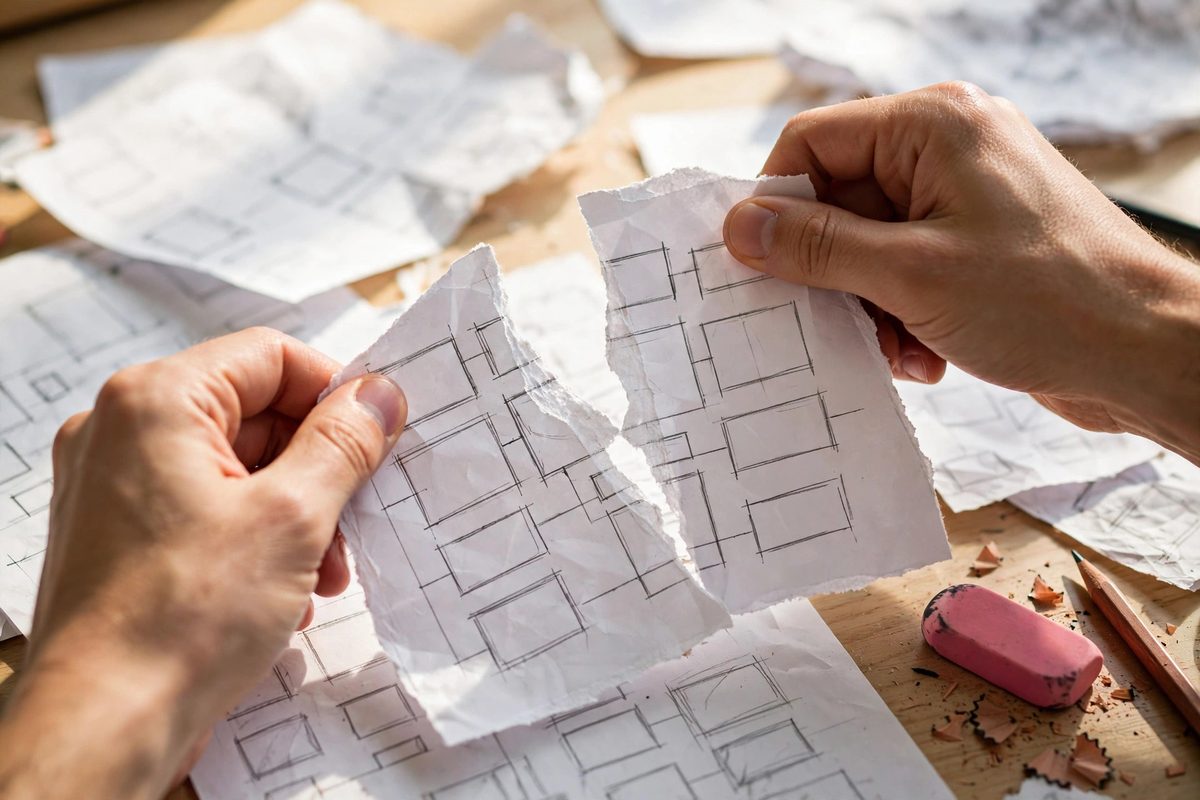

Nobody budgets for the apology. It arrives anyway: the launch that lands wrong, the feature that solves a problem nobody had, the redesign that sends your most loyal users to a support forum to ask each other what happened. Then come the artifacts nobody planned to produce: the rollback, the mea culpa email, the “we heard you” post. Every one of them is a design review. It is just being held at the worst possible time, in public, with the entire customer base in the room.
The most expensive sentence in product development
“We'll find out when it ships” sounds like pragmatism. It is the most expensive sentence in product development, because shipping is the priciest way there is to ask a question. By the time real people answer it, you have paid for the design, the engineering, the testing, the launch, and the support queue that forms when the answer goes public. If the answer is no, you pay for most of that list a second time, and then you pay for the apology on top of it.
The strange part is that the question itself was never expensive. Can a new customer finish the core task without help? Does the pricing make sense at a glance? Will anybody take the second step, the one the whole business case stands on? Questions like these can be asked for the price of a few screens and an afternoon. Teams ask them anyway at the one moment when the answer costs the most, and then act surprised by the invoice.
The curve, with an honest word about it
Software economics has had a picture of this for decades. Barry Boehm's research, beginning with Software Engineering Economics in 1981, found that the cost of fixing a problem climbs steeply the later in the process it is found. Boehm and Victor Basili later summarized the evidence in its strongest form:
Honesty requires the footnote, so here it is, in the open rather than under the rug: later studies are less clear-cut. The same review notes that the size of the escalation depends on the process and the kind of system, and that for small, non-critical systems the late fix may cost closer to five times the early one. Five or a hundred, the practical conclusion does not move: a problem is cheapest to remove before design and code have been built on top of it. The same fix costs an afternoon as a sketch, a sprint in development, and a quarter in production, and in production it bills you in a second currency, customer trust, the one currency that does not refill on a schedule.
What a prototype actually buys
A prototype is not a smaller product. Nielsen Norman Group defines it as a hypothesis: a candidate answer to a specific design problem, tested by watching people work with it. That definition matters, because it rules out the politest and most useless question in the building, “Do you like it?” People will answer that one kindly, and their kindness will cost you a quarter. The questions worth buying answers to are ruder and more specific: Can a new user complete the core task without help? Does the pricing model make sense at a glance? Will anyone do the second step?
What the money buys, concretely, is three things. Evidence instead of opinions: five people attempting the real task teach you more than fifty stakeholders predicting it in a conference room, because prediction is where office politics lives and observation is where it dies. A shared object: arguments about a hypothetical can run for weeks, because everyone is defending a different imaginary product, while one watched session ends most of them in an hour. And permission to kill the idea while killing it is still a saving instead of a write-off. Every project needs a dignified exit for its bad ideas, and the prototype is the only exit with a low door. Low fidelity widens that door on purpose:
This is the build-measure-learn loop from The Lean Startup with the emphasis where Ries put it. The learning is the product of the exercise. The prototype is simply how you buy the learning at the lowest price it will ever be offered.
The method, in order
Ask the question while it is still cheap. In that order, or not at all.
- Write the question first, in one sentence. Not “test the onboarding,” which is an activity, but “can a first-time user reach a finished report without asking for help,” which is a question with a yes or a no hiding inside it. If the team cannot state the question, it is not ready to build the prototype.
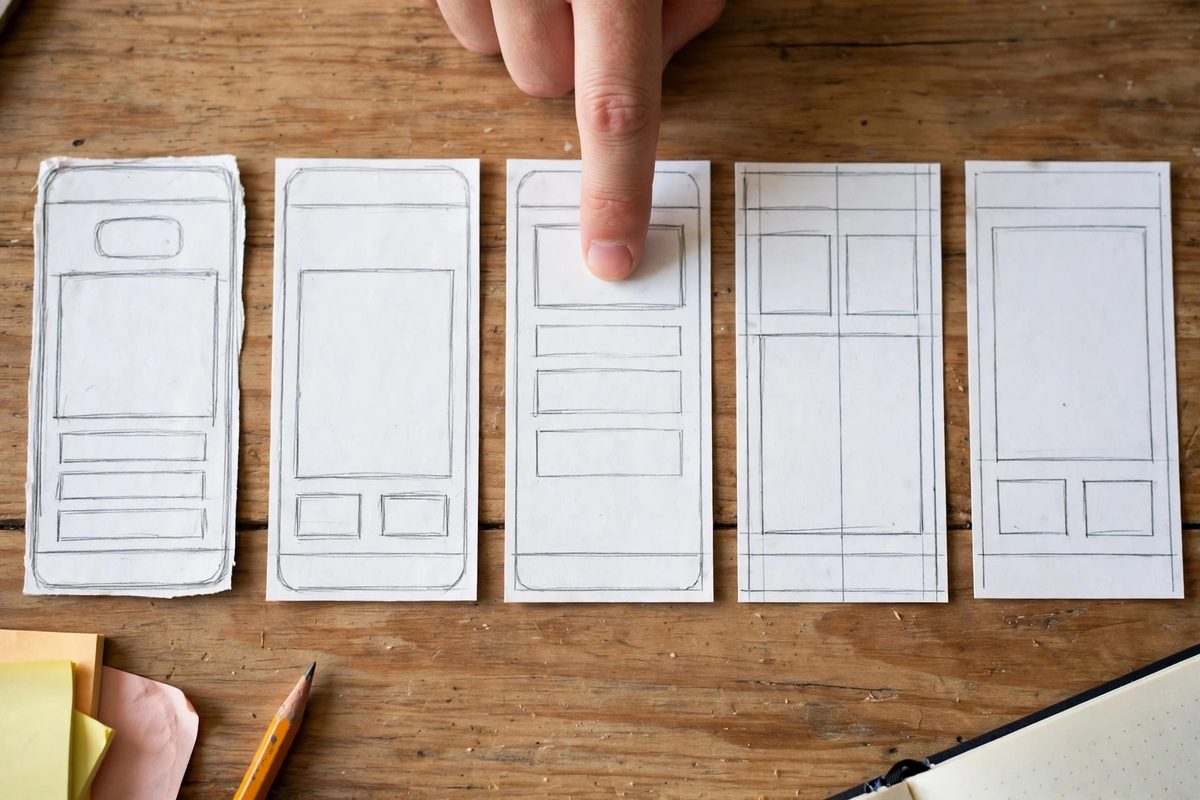
- Build the least thing that can answer it. Match the fidelity to the question. Paper screens and a colleague playing computer can settle a question about flow. A pricing question needs real words and real numbers, because people do not react to filler text the way they react to a price. Build nothing the question did not order.
- Put five people on the real task, and watch. People who match the customer, doing the thing the product exists to do, thinking out loud. Do not demo. Do not explain. The confusion you paid to see will not survive you explaining it away in the room, so let it live long enough to teach you something.
- Decide in the room, while the evidence is warm. Kill it, fix it, or commit to building it. The one verdict a prototype test should never return is “interesting,” followed by building the thing anyway and finding out at launch, in front of everyone.
But we do not have time to test
Every team that ships an apology said this first, usually in a meeting about a deadline. The arithmetic never survives contact with the calendar. A focused prototype effort runs in days to a couple of weeks. The rework it prevents runs in quarters. Skipping the test does not save the time. It defers the time, adds interest, and schedules the payment for the worst moment on the calendar, right after launch, when everyone is watching.
The second version of the objection says that people cannot judge unfinished work. The research points the other way: a rough prototype lowers the pressure on the people testing it. They can see they are judging a sketch, they feel freer to dislike it, and their dislike, delivered in a quiet room in front of five people, is the cheapest sentence your project will ever hear. The finished product receives the same honesty at launch volume, with names attached and screenshots.
An apology is a prototype review conducted by your entire customer base, at full price, on the record.
So test the idea while it is still an idea. It is the only stage of the work where being wrong is cheap, private, and genuinely useful, and it may be the only stage where being wrong feels like progress, because it is. Nobody approves a budget line for the apology, and everybody pays it. The prototype is the same information bought earlier, at the sketch price, from five volunteers instead of from the whole market. Buy the question. Skip the apology.
Was this useful?
The short version
Everything above comes down to one habit: look at your product the way your customers have to. If you would like a senior set of eyes on yours, that is the work I do.
Sources
- Boehm, B. W. (1981). Software Engineering Economics. Prentice Hall. The origin of the cost-of-change curve: the cost of fixing a problem rises steeply the later it is found.
- Burkin, V. (2023). Mitigating Risks in Software Development through Effective Requirements Engineering: a review of the evidence on the cost of requirements defects, including the Boehm and Basili summary and the later, less clear-cut studies. arXiv. https://arxiv.org/html/2305.05800v2
- Nielsen Norman Group. UX Prototypes: Low Fidelity vs. High Fidelity: a prototype is a hypothesis, tested by watching people work with it, and ripping up a prototype is cheap where ripping up code is expensive. nngroup.com. https://www.nngroup.com/articles/ux-prototype-hi-lo-fidelity/
- Ries, E. (2011). The Lean Startup. Crown Business. Build, measure, learn: the learning is the product of the exercise. Book record at en.wikipedia.org. https://en.wikipedia.org/wiki/The_Lean_Startup